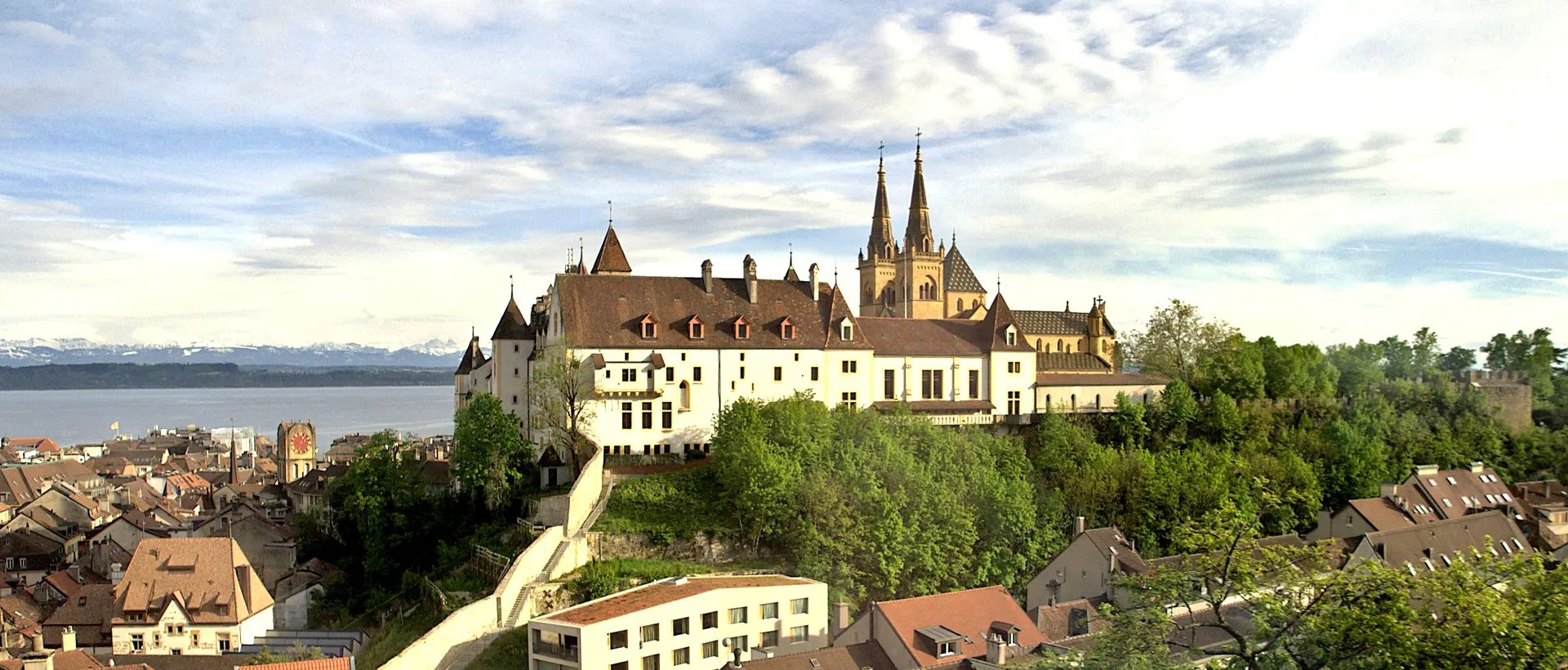
If you have never set foot in Neuchâtel, picture a small town spread along a lake, with a castle and a church on the hill above the old center, steep streets running down to a promenade, and a long history of watchmaking in the region. It is quieter than Zurich or Geneva, and many newcomers like exactly that. This guide walks you through what living in Neuchâtel is like, in the order you will meet it: the place, the language, housing, school, getting around, and your first days.
What Neuchâtel is like day to day
Neuchâtel is the main town of the canton of Neuchâtel (NE) in western Switzerland. In 2025 it had 45,466 permanent residents, according to the Federal Statistical Office (FSO). Of these, 14,982 were foreign nationals, which is 33% (FSO, 2025). So you would not be the only newcomer on your street.
Daily life is compact. Shops, cafés, the lake promenade and the train station are close together, and a lot of people walk or cycle. The slope is real, though: the town climbs up from the water, so expect some uphill walking.
Picture a couple arriving from Singapore with a toddler. They will probably spend their first weekend on the lakefront, find the market, and learn quickly that most errands are done within a short walk. That small scale is the main appeal.
Language: what you will hear
French is the language you will mostly hear and read on signs, forms and at the town hall. Many people in work and study settings also speak English, but do not count on it for official paperwork or at the doctor's office. If you are coming from the UK, the US, India or Australia, plan to start French lessons before you leave. Even a basic level makes the first weeks much smoother.
The canton's official language setting is something to confirm with the canton itself. For daily life, assume French and ask the local office what they can offer in English.
Neighborhoods and nearby communes
The old town and the streets near the lake are the most central and the most walkable. Higher up the hill you find quieter residential areas with views over the water, and nearby communes (Gemeinde in German, commune in French) offer more space and a village feel. Because the town is small, living a little outside the center is a real option, as long as you check the train and bus links first.
When you compare areas, think about three things: how you will get to work or school, how steep the walk is with a stroller or in winter, and whether you want lake views or a quieter street. If you are weighing Neuchâtel against other places, the city comparison tool and our pages on Lausanne and Bern give a different picture.
Finding a home
Renting is the normal route for newcomers. Here is how it usually goes, step by step:
- Decide your budget and the number of rooms. In Switzerland, rooms are counted excluding the kitchen and bathroom, so a "3-room" flat has two bedrooms and a living room.
- Prepare your rental file before you leave: ID, proof of income, and an extract from the debt collection register (Betreibungsauszug in German, extrait du registre des poursuites in French). Our rental file check shows what is usually asked.
- Apply through the property manager (régie in French). Landlords often receive many applications, so a complete file helps.
- If accepted, you sign the lease and pay a rent deposit (Mietzinsdepot in German), which is held in a blocked account. The amount is set by the lease and the rules, so check it with the landlord.
Here is a sense of the rent levels. The FSO publishes average net rents for the canton of Neuchâtel (not the town alone). In 2024 the average net rent across all sizes was CHF 1,091 per month (FSO). Net rent means without heating and extra costs, which are usually billed separately.
The chart below shows the 2024 average net rent by number of rooms in the canton of Neuchâtel, from the FSO table. Treat these as orders of magnitude, not as prices for a specific flat.
A 3-room flat averaged CHF 1,024 per month and a 4-room flat CHF 1,303 per month (FSO, 2024). A family needing five rooms saw an average of CHF 1,613 per month (FSO, 2024). Actual listings, especially newly advertised ones near the lake, can sit above or below these averages.
On availability, the FSO reported a vacancy rate of 1.64% for the canton of Neuchâtel on 1 June 2026 (FSO). The rate for the town itself is not something we can state, so ask a local property manager how tight the market is in the area you like.
Permits and registering with the commune
Your right to live in Switzerland depends on your nationality and your situation, and the authorities decide, not us. In the canton of Neuchâtel, residence and permit matters go through the cantonal migration office, the Service des migrations (SMIG). You can find it on the canton's official page, and the SEM keeps the official list of cantonal authorities.
After you arrive, you have to register with the commune. The usual timeframe is within 14 days of arrival, but it can vary by commune, so confirm it with the local office (ch.ch). Bring your ID, your residence or work permit, and proof of health insurance. For a first orientation, the permit finder explains the main routes, and the immigration support page describes how a specialist can look at your case.
Schools and families
Public schools in Neuchâtel teach in French. Children who arrive without French are usually helped to catch up, and younger children often adapt fastest. Some families prefer a private or international school; we cannot name or rank any here, so ask the canton or the schools directly about places, fees and language of instruction.
Picture a family from Mumbai with a ten-year-old and a five-year-old. The five-year-old may settle into the local kindergarten within weeks, while the older child may need extra French support. The school choice tool helps you think through the options before you decide.
Getting around and reaching the airport
Neuchâtel has a railway station with regular trains, plus local buses. Many residents commute by train to other towns in western Switzerland. We cannot give travel times or ticket prices here, so check the timetable and passes on the SBB (Swiss Federal Railways) website and with the local transport operators. As a rule, Swiss public transport is dense and punctual, and you can often live without a car.
For international flights you will use one of the larger airports in Switzerland. Compare the options on the rail timetable once you know your address. For a wider view of living costs, read the cost of living in Switzerland and see how a very different town feels in Zurich or St. Gallen.
Your first days in Neuchâtel
- Register with the commune within the usual timeframe and ask about your permit steps
- Arrange basic health insurance, which is compulsory for residents
- Open a bank account for rent and salary
- Sign up for French lessons
- Learn the bus and train routes for your daily trips
- Enroll your children at school through the commune
If you want help with the order of these steps, the request at the bottom of the page lets you describe your move, and a relocation company that fits your needs can then get in touch. You can also start with your details here.
Frequently asked questions
Is Neuchâtel a good place to live for expats?
Many newcomers find it calm, walkable and friendly. About 33% of residents are foreign nationals (FSO, 2025), so international newcomers are a normal part of the town. The trade-off is that it is small and mostly French-speaking.
What language do people speak in Neuchâtel?
French is the language you will meet most often. English is common in some workplaces, but forms and official contacts are mostly in French. Start learning before you move.
How big is Neuchâtel?
It had 45,466 permanent residents in 2025 (FSO). That makes it a small town by international standards, with everything close by.
How much does it cost to rent in Neuchâtel?
The FSO average net rent for the canton in 2024 was CHF 1,091 per month across all sizes (FSO). The figure is for the canton, not the town, and it excludes extra costs. Real listings vary.
Is it hard to find an apartment?
The canton's vacancy rate was 1.64% on 1 June 2026 (FSO). A complete file, prepared in advance, makes your application stronger. Ask a property manager about the local situation.
What documents do I need to rent?
Usually ID, proof of income and a debt collection register extract, but each property manager sets its own list. Our rental file check gives a good starting point.
Do I need a car?
Many residents manage without one thanks to trains and buses. Check your daily routes first, especially if you plan to live outside the center.
Where do I register after arriving?
At the commune where you live. The usual timeframe is 14 days, but confirm it locally (ch.ch).
Which office handles my permit?
The cantonal migration office, the Service des migrations (SMIG), deals with permits in the canton. The authorities decide on every application.
Will my children go to school in French?
Public schools teach in French, and support for new arrivals exists. Ask the commune or canton what is offered for your child's age.
Can I live in Neuchâtel and work elsewhere?
Many people commute by train from Neuchâtel to other towns. Check the timetable for your workplace before choosing a home.
Is health insurance compulsory?
Yes, basic health insurance is required for residents of Switzerland. You will need proof of cover when you register with the commune.
Sources
- Federal Statistical Office (FSO), permanent resident population (STATPOP)
- Federal Statistical Office (FSO), average net rents, table T 09.03.03.01
- Federal Statistical Office (FSO), vacant dwellings on 1 June 2026
- State Secretariat for Migration (SEM), cantonal migration authorities
- Canton of Neuchâtel, Service des migrations (SMIG)
- ch.ch, the Swiss authorities' portal