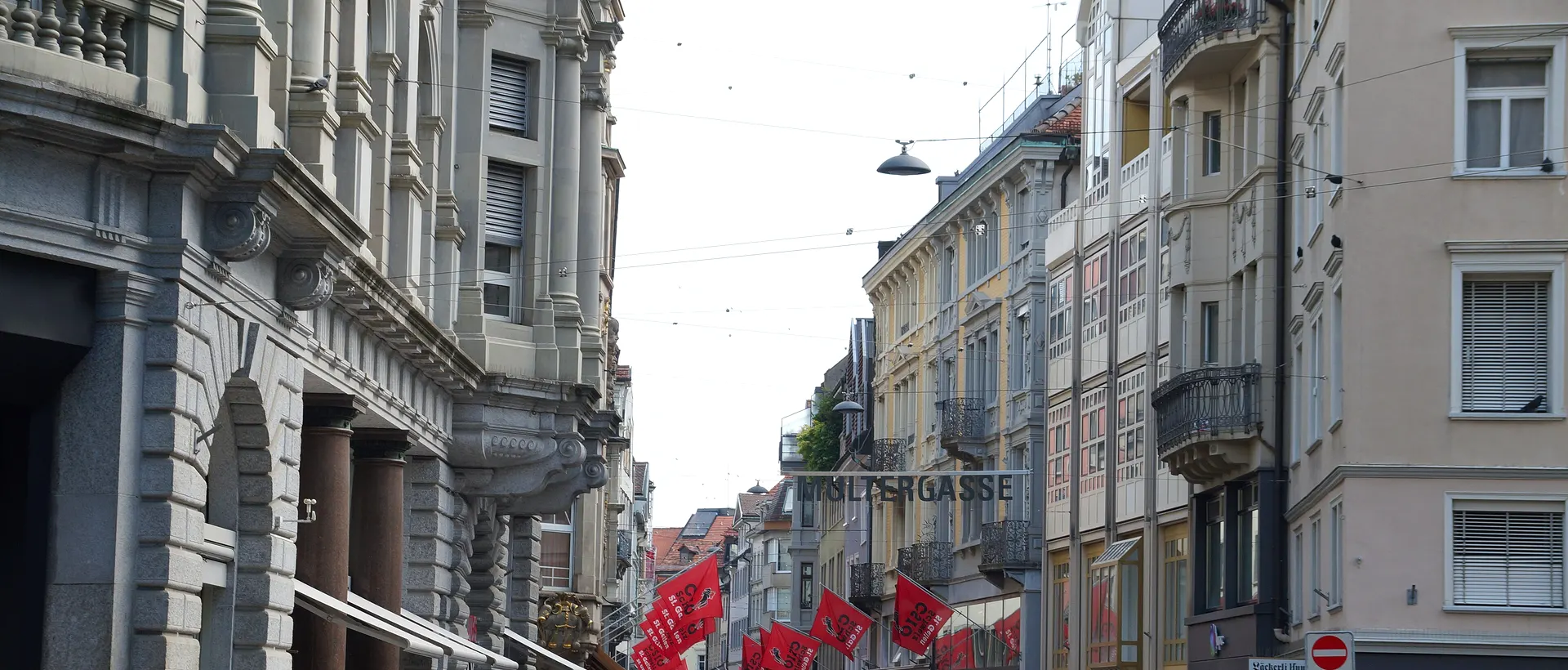
If you have never set foot in eastern Switzerland, St. Gallen can feel like a name on a map. This guide gives you a picture of everyday life there, so you can plan your move from abroad one step at a time.
A first picture of the city
St. Gallen grew around a medieval abbey, and its old town still has narrow lanes, painted house fronts and a famous baroque abbey library. It sits in the north-east of the country, in a hilly landscape, and it feels more like a lived-in regional town than a showcase city.
According to the Federal Statistical Office (FSO), the city had 79,487 permanent residents in 2025. Of these, 27,471 were foreign nationals, which is 34.6% (FSO, 2025). In plain terms, you will not be the only newcomer: international neighbors, colleagues and school classmates are part of normal life here.
Daily life is mostly in German. People speak Swiss German with each other and standard German in writing and at school. You do not need fluent German on day one, but a few lessons before you leave will make shops, offices and neighbors much friendlier.
What a normal week feels like
Think of a compact center where you can walk between the station, the old town, cafés and the weekly market. Many residents also live in quieter hillside districts and in neighboring municipalities, then reach the center by bus or train.
Here is an example: a couple arriving from Singapore might choose an apartment close to the station, so one partner can commute and the other can walk to language classes. A family arriving from Manchester with two children might look at a calmer district near a primary school instead. Both choices are normal, and both depend on the same first step: knowing what you need before you search.
If you are still deciding between places, the city comparison tool helps you put several Swiss cities side by side. For a very different big-city picture, read Arriving in Zurich or the page on Neuchâtel.
Housing: what to expect
Most newcomers rent. Swiss landlords and property managers (régie, or Verwaltung in German) usually ask for a full application file: identity papers, proof of income, and often a debt-collection extract. Preparing these from home saves days later. The rental file check shows you what a complete file looks like.
Rents are best read as an order of magnitude. The FSO reports these average net monthly rents for the city, pooled over 2022-2024: CHF 740 for one room, CHF 1,037 for two rooms, CHF 1,240 for three rooms, CHF 1,403 for four rooms and CHF 1,702 for five rooms (FSO). The overall average across all sizes was CHF 1,264 per month (FSO, 2022-2024). Net rent means without extra charges, so ask what is included.
For the wider canton of St. Gallen, the FSO gives CHF 1,343 as the overall average net rent in 2024 (FSO). Asking rents for new listings are often higher than averages that include long-running leases, so treat these figures as a starting point, not a quote.
On 1 June 2026, the FSO counted 1.16% of dwellings as vacant in the canton (FSO). We do not have a reliable figure for the city alone, so do not assume it matches the canton. In practice, ask early, answer quickly and keep your documents ready.
For a wider budget picture, see the cost of living in Switzerland.
Schools and childcare
Public schooling is organized by the canton and the municipality, and your child's school is usually linked to your address. That is one reason to decide on a neighborhood with school in mind. The school choice tool explains the main school types in Switzerland.
Some families prefer an international school. We cannot give you a verified list of English-language options in St. Gallen, so ask the canton or the schools directly about places, language support and how admission works for children who arrive mid-year.
Getting there and getting around
Check routes and travel times before you book flights and a moving date. We have not verified specific connections, so we will not guess at journey times. Ask the people you will deal with, such as your employer or the transport operators, about the best way to arrive with luggage.
Once you live in the city, most newcomers rely on walking, buses and trains, and some also keep a car. Whether you need one depends on the district you choose and your daily routine.
Your permit and the cantonal office
Your right to live in Switzerland depends on your nationality, your reason for coming and your situation. Citizens of EU and EFTA countries and citizens of other countries follow different routes. The permit finder gives you a first orientation, and a specialist examines your case after you send your request.
In St. Gallen, the authority for residence matters is the Migrationsamt des Kantons St.Gallen, the cantonal migration office. The State Secretariat for Migration (SEM) lists all cantonal offices on its official page. Only the authorities decide on permits.
Your first days on arrival
After arriving, you must register with the municipality. A common deadline is 14 days, but it can vary by municipality, so confirm it locally (ch.ch). Bring your passport or ID, your residence or work permit and proof of health insurance.
Use this short checklist as a starting point:
- Check which permit route applies to you
- Prepare your rental application documents
- Ask your employer or school about start dates
- Book temporary housing for the first days
- Plan your municipal registration right after arrival
You can also build your own list with the personal checklist tool or plan the timing with the relocation calendar.
Is St. Gallen right for you?
It suits people who like a smaller, walkable city with history, who are happy to learn German, and who want a calmer pace than the big financial centers. If you prefer an international, English-speaking environment from day one, compare more than one city first.
When you are ready, tell us about your move in the request form. We work with relocation companies in Switzerland and, depending on your needs, put you in touch with the one that fits.
Frequently asked questions
Is St. Gallen a good place to live for expats?
It can be, especially if you like a compact, historic city and are willing to learn German. About 34.6% of residents are foreign nationals (FSO, 2025), so newcomers are a normal part of local life.
What language do people speak in St. Gallen?
Daily life is mostly in German, with Swiss German spoken among locals. English helps in many workplaces, but you will use German in offices, schools and shops.
How many people live in St. Gallen?
The FSO counted 79,487 permanent residents in 2025. It is a mid-sized Swiss city, not a large metropolis.
How much is rent in St. Gallen?
The FSO average net rent across all apartment sizes in the city was CHF 1,264 per month in 2022-2024 (FSO). Individual listings vary with size, district and condition.
Is it cheaper than Zurich?
We do not compare exact prices here, because averages come from different surveys. Use the city comparison tool to see cities side by side.
How hard is it to find an apartment?
The canton had 1.16% vacant dwellings on 1 June 2026 (FSO). A complete application file and quick replies usually help, but the outcome depends on the landlord.
What documents do landlords ask for?
Typically identity papers, proof of income and often a debt-collection extract. Requirements differ, so ask each property manager what they want to see.
Can I rent before I arrive in Switzerland?
Some newcomers do, others book a temporary stay and search on site. Ask the landlord about signing from abroad and about any deposit rules before you commit.
Which permit do I need?
It depends on your nationality, your reason for moving and your situation. The authorities decide, and a specialist can look at your case after your request.
Where do I register after I arrive?
At your municipality, usually within 14 days, though this can vary (ch.ch). Bring ID, your permit and proof of health insurance.
Do I need health insurance?
Basic health insurance is part of the registration process in Switzerland, and you are asked for proof when you register. Ask your municipality how it handles the timing.
Are there international schools?
We cannot confirm a verified list, so ask the canton or the schools directly. Public schools are also open to families who arrive from abroad, and the municipality can explain placement.
Do I need a car in St. Gallen?
Not always. It depends on your district and your routine, so check commuting options before you decide.
How do I reach the airport from St. Gallen?
Connections and travel times are not verified here. Check them with the transport operators before you book.
Who do I contact about my residence status?
The cantonal migration office, the Migrationsamt des Kantons St.Gallen. Do not rely on forum advice for permit questions.
Sources
- Federal Statistical Office (FSO), permanent resident population
- Federal Statistical Office (FSO), average net rents in the ten largest cities
- Federal Statistical Office (FSO), average net rents by canton
- Federal Statistical Office (FSO), vacant dwellings by canton
- State Secretariat for Migration (SEM), cantonal migration authorities
- ch.ch, the Swiss authorities' guide for residents