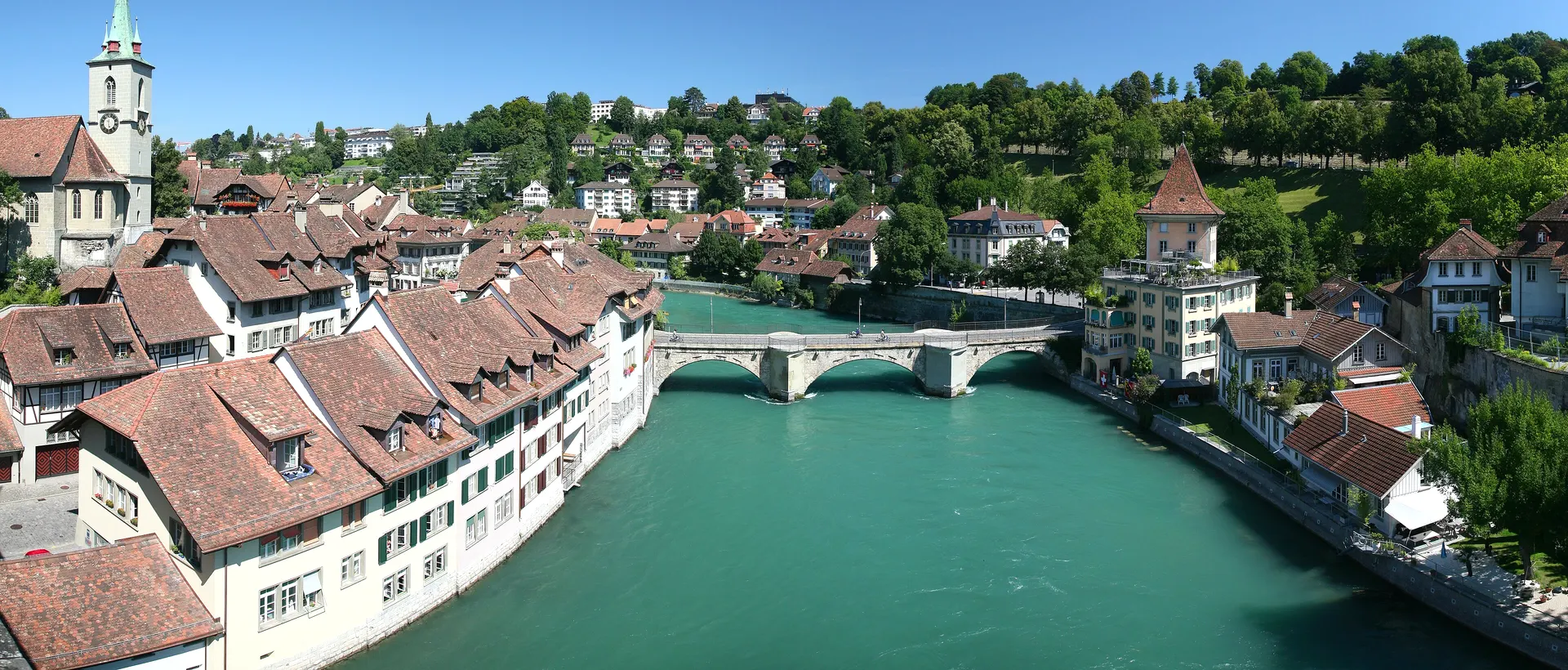
If you are searching for what living in Bern is really like, start with the pace. Bern is the seat of the Swiss federal government, yet it feels more like a river town than a political center. People walk, cycle and swim in the Aare in summer, and the old town is compact enough to cross on foot.
This page is for someone who has never lived here. It follows the order you will probably need: the place and its language, the housing market, schools, the paperwork on arrival, and a short list of first steps.
What Bern feels like day to day
Bern is called the "federal city" in Switzerland. Parliament and the federal administration sit here, so you will find civil servants, diplomats, students and families from many countries. The streets are quiet in the evening, the arcades keep you dry when it rains, and most daily errands are close to home.
Example: a couple arriving from Singapore might expect a capital to be busy and loud. Many newcomers are surprised that Bern is calmer than Zurich or Geneva, and they often describe it as easy to settle into. If you are still choosing between cities, the city comparator and the guide to Zurich can help you see the differences.
Who lives here
About 138,562 people lived in the city of Bern in 2025, and 35,896 of them were foreign nationals, or 25.9% of residents (FSO, STATPOP 2025). In practice, you will not be the only newcomer in your street, school or office.
Language: German, French and what you hear
The canton of Bern is officially bilingual, with French and German (Federal Government, Presence Switzerland). The city of Bern itself is German-speaking: official notices, schools and most shops work in German, and people speak a Swiss German dialect among themselves.
Do not worry if you do not speak any German yet. Many people in services and offices will switch to English, but you will have a much easier time with neighbors, landlords and your child's teacher if you start lessons before you leave home. Writing and official forms are in standard German, which is the version most courses teach.
Housing: what to expect
Housing is the part that surprises most newcomers. Most people in Switzerland rent, and landlords usually want a complete file before they will consider you. The rental file check shows what to prepare from abroad.
Rents in the city and the canton
The Federal Statistical Office (FSO) publishes average net rents, which means rent without heating and utilities. In the city of Bern, the 2022-2024 cumulative average is CHF 1,413 per month across all sizes, and CHF 1,421 for a 3-room apartment (FSO structural survey). For the whole canton of Bern in 2024, the average is CHF 1,319, and CHF 1,288 for 3 rooms (FSO). Treat all of these as orders of magnitude, since individual listings vary a lot by neighborhood and condition.
If you count rooms the Swiss way, remember that the kitchen is not included: a "3.5-room" apartment has a living room and two bedrooms. The chart below compares city and canton averages by size.
How tight is the market?
On 1 June 2026, 1.04% of dwellings in the canton of Bern were vacant (FSO). A low rate like this means you should expect competition for good apartments and should start looking early. The rate for the city alone is not available here, so do not assume it matches the canton figure.
Practical steps
- Prepare your documents before you travel: ID, proof of income or an employment contract, and a debt-collection extract if you can obtain one.
- Ask whether the landlord wants a deposit and how it is held.
- Expect a flatshare or a temporary furnished stay to be useful while you search.
- Compare costs with home using the cost of living in Switzerland, Switzerland or the UK or Switzerland or the US.
Schools and children
Public schools in Switzerland are organized by the canton and municipality, so the school your child attends depends on where you live. In the city of Bern, instruction is mainly in German. Younger children often adapt fast, while older children may need extra support.
I cannot name international schools here, because no official list was confirmed for this page. Ask the canton or the school directly, and use the school choice tool to think through which type of school suits your child before you pick a neighborhood.
Example: a family with a six-year-old and a twelve-year-old moving from Mumbai might choose a public school for the younger child and look at other options for the older one. A specialist can look at your situation through the request at the bottom of the page.
Getting around and arriving
Bern has a compact public transport system and the old town is easy on foot. I have no verified information on airport connections, travel times or season passes for this page, so check timetables and ticket options with the rail and local transport operators before you decide where to live.
The migration office and your first days
Residence permits in the canton of Bern are handled by the Office for Migration and Civil Status (Amt für Migration und Personenstand, MIP). You can find the office on its official website and in the list of cantonal authorities published by the State Secretariat for Migration (SEM). Which permit you need depends on your nationality and your reason for moving. The permit finder gives you a first idea, and the authorities decide in the end.
After you arrive, you must register with your municipality. A common deadline is 14 days, but it can vary by municipality, so confirm it with the local office before you travel. Bring your ID, your residence or work permit and proof of health insurance (ch.ch).
A simple first-weeks checklist
- Register with the municipality (Gemeinde) of Bern
- Arrange basic health insurance
- Open a bank account
- Enroll your children at school
- Start German lessons
For a longer plan, see your relocation calendar. If you want to compare Bern with its biggest neighbor, read Zurich or Geneva? and the guide to immigration support.
Frequently asked questions
Is Bern a good place for newcomers?
Many newcomers find it calm, safe and easy to get around. It suits people who like a smaller city with a lot of nature. Fast-paced nightlife or a large international scene are better found elsewhere.
What language is spoken in Bern?
The canton is officially bilingual in French and German (Presence Switzerland). The city of Bern is German-speaking, with a Swiss German dialect in daily conversation.
Do I need to speak German?
It is not required to arrive, but it helps for daily life, work and school. Start learning standard German before you leave if you can.
How many foreign residents live in Bern?
In 2025, 35,896 residents were foreign nationals, or 25.9% of the city's population (FSO).
How much is rent in Bern?
In 2022-2024, the average net rent in the city was CHF 1,413 per month across all sizes (FSO). Your own cost depends on size, area and timing.
Is it easy to find an apartment?
It is competitive. About 1.04% of dwellings in the canton were vacant on 1 June 2026 (FSO), so prepare your file early.
Which authority issues residence permits?
The Office for Migration and Civil Status of the canton of Bern (MIP) handles permits in the canton. The State Secretariat for Migration (SEM) lists all cantonal offices.
When must I register after arriving?
A 14-day deadline is commonly cited, but it can vary by municipality. Confirm it with the local office before you travel (ch.ch).
Which documents will I need on arrival?
Plan for ID, your permit or work document and proof of health insurance. The municipality can tell you if it needs anything else.
Which school should my child attend?
That depends on your address, your child's age and language level. Use the school choice tool to prepare your questions.
Can someone help me with my move?
Yes. You can send a request at the bottom of this page, and a specialist will look at your situation.
Sources
- Federal Government (Presence Switzerland, FDFA), multilingualism
- Federal Statistical Office (FSO), STATPOP population statistics
- Federal Statistical Office (FSO), structural survey, rents in the largest cities
- Federal Statistical Office (FSO), average net rents by canton
- Federal Statistical Office (FSO), vacant dwellings by canton
- State Secretariat for Migration (SEM), cantonal migration authorities
- Canton of Bern, Office for Migration and Civil Status (MIP)
- Swiss Confederation, ch.ch