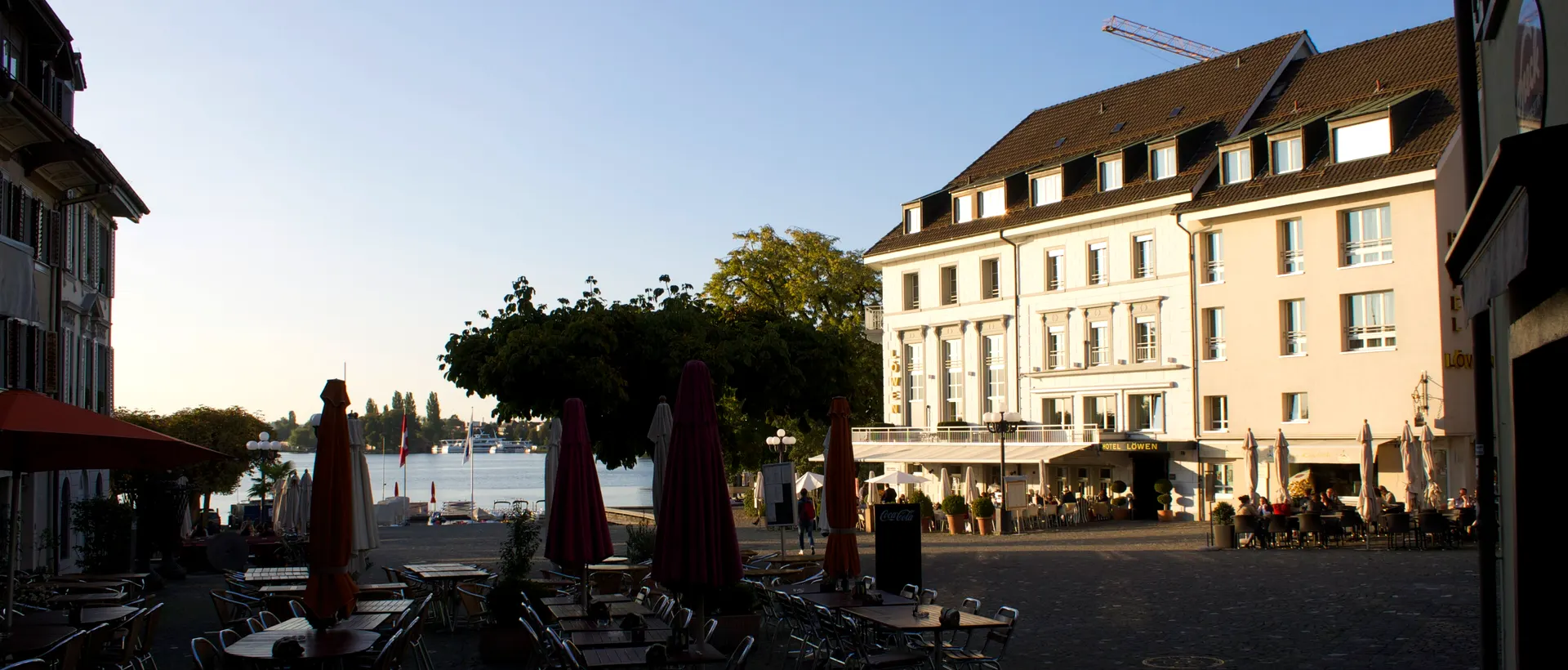
If you have never set foot in Zug, picture a lakeside town with an old center, a calm waterfront and a very international population. This page is for people living abroad who are considering living in Zug and want to understand the place before they plan anything. It covers the setting, housing, schools, getting around and the first days after arrival.
Zug at a glance
Zug (the town and the canton share the name, abbreviated ZG) sits on a lake in central Switzerland, between the larger cities of Zurich and Lucerne. The old town is compact, with towers and narrow lanes, and the lakeside promenade is where much of daily life happens on a sunny day.
In 2025, the permanent resident population of the town was 32,160 people (FSO). Of these, 12,007 were foreign nationals, which is 37.3% (FSO). So if you arrive from London, Bangalore, Singapore or Chicago, you will not be the only newcomer on your street.
32,160 people
Permanent residents, 2025
Source: Federal Statistical Office (FSO)
12,007 people
Foreign residents, 2025
Source: Federal Statistical Office (FSO)
37.3%
Share of foreign residents, 2025
Source: Federal Statistical Office (FSO)
Language and everyday rhythm
Zug is in the German-speaking part of the country, so signs, forms and school letters are usually in German. Many residents speak English at work, and international families often get by well in daily life. Learning some German still opens doors with neighbors, the municipality and your child's teachers. Day to day, expect a quiet, orderly rhythm: shops close early on Sundays, recycling follows strict rules and trains run on time.
Housing in Zug
The rental market is the part that surprises most newcomers. The Federal Statistical Office does not publish a figure for the town alone, so the numbers below are for the canton of Zug as a whole. In 2024, the average net rent in the canton was CHF 2,024 per month, all dwelling sizes together (FSO).
A family of four looking for a four-room home would see an average of CHF 2,270 per month in the canton (FSO). These are averages of existing rents, so a home advertised today can cost more. Treat them as an order of magnitude, not as a quote.
Availability is just as important as price. On 1 June 2026, the vacancy rate in the canton was 0.2% (FSO). That is very low, which means competition for each listing. A figure for the town itself is not available, so it would be wrong to read the cantonal rate as the town's rate.
Preparing from abroad
You cannot do everything before you land, but you can prepare a good rental file. Typical items include an ID, proof of income or an employment contract, and a reference letter from a previous landlord. The rental file check shows what a complete file looks like, and the Swiss cost of living overview puts rents next to other expenses.
Some newcomers rent a short-term furnished place first and look for a long-term home once they are on site. If you want help with the search, the request form at the bottom of the page lets you describe your situation.
Schools and children
Public schools in the canton teach mainly in German. Families who do not speak German often look at international schools, and children can also join the local school with language support. We do not list individual schools here because there is no official, verified list we can point to; the cantonal authorities can tell you what exists and what the admission rules are.
The school choice tool helps you think about which type of school suits your child's age and language level before you contact anyone.
Getting around
The town is small enough to cross on foot, and the bus and rail network connects it to the neighboring cities. We have not verified specific journey times, so check the national rail timetable before you decide where to live. Many people choose a home near the station or the lake so they can do without a car.
If you plan to drive, a foreign license is usually only valid for a limited period, and the rules differ by country of origin. Ask the cantonal authorities what applies to you.
Permits and the migration office
Your right to live in Zug depends on your nationality and your situation: EU/EFTA citizens follow a different path from people from third countries such as the US, India or Singapore. The permit finder gives a first idea in four questions, and the immigration support page explains how a specialist can review a case.
For permit questions, the competent body is the Amt für Migration, Kanton Zug (the Zug migration office). Its official page is the Canton of Zug Migration Office, and the SEM list of cantonal authorities confirms it. The authorities, not this site, decide on any permit, and nothing is assured in advance.
Your first days
Here is the usual order of events once you have a home:
- Register with the municipality (Gemeinde) where you live. The commonly cited period is 14 days after arrival, but it can vary by municipality or canton, so confirm it locally.
- Bring your ID, your residence or work permit and proof of health insurance to the registration.
- Arrange basic health insurance, which is compulsory for residents.
- Open a bank account and organize school places for children.
The relocation calendar turns this into a timeline, and the personal checklist builder lets you tailor it to your family.
An example: a couple from Toronto
Example: a couple with one child arrives from Toronto. They first sort out the permit with the employer, then collect rental documents at home, visit for a few days to see the lake and the schools, and register with the municipality as soon as the keys are in hand. This is an illustration, not a real case.
Zug compared with other places
Zug has a reputation as a wealthy, business-friendly town, and many people compare it with Zurich. Our page on Zug or Zurich sets taxes, rent and lifestyle side by side. To see other options, read about Zurich, Lucerne or Bern, or use the city comparator. If you come from abroad, the pages comparing Switzerland with the UK and the US are a useful reality check.
Frequently asked questions
Is Zug a good place for expats?
For many newcomers, yes. About 37.3% of the town's residents are foreign nationals (FSO), so the community is used to people arriving from abroad. Whether it suits you depends on your budget, your job and your family.
What language is spoken in Zug?
German is the everyday language of the town and its public services. English is widely used in business, but official letters and school communication are generally in German.
How expensive is renting in Zug?
In 2024, the average net rent in the canton was CHF 2,024 per month (FSO). That figure covers the canton, not just the town, and new listings are often priced higher.
Is it hard to find an apartment?
Competition is strong. The canton's vacancy rate was 0.2% on 1 June 2026 (FSO), so a complete rental file and some patience help a lot.
Can I find a place before I arrive?
Some people do, usually with a complete file and a clear start date. Others rent a temporary place first and search on site. Both approaches are common.
Which permit do I need to live in Zug?
It depends on your nationality, your job and your family situation. The permit finder gives a first orientation, and the cantonal migration office makes the decision.
Where is the migration office?
The Amt für Migration, Kanton Zug handles permit questions for the canton. Its official page is linked in the sources below.
How do I register after arriving?
You report your arrival to your municipality with your ID, permit and proof of health insurance. The usual period is 14 days, but it can differ by municipality or canton, so check locally (ch.ch).
Are there international schools in Zug?
International schools exist in central Switzerland, but we have no verified list for Zug. Ask the cantonal authorities about options and admission rules.
Do I need a car in Zug?
Many residents get by with trains, buses and walking. Check the rail timetable for the area where you are considering a home.
Is health insurance compulsory?
Yes, basic health insurance is compulsory for residents of Switzerland. A specialist can look at which options fit your situation.
Can Relocation Swiss move me to Zug?
No. This site connects you with relocation companies in Switzerland. Through Tell us about your move, you describe your needs and are put in touch with a company that fits them. You can also read about relocation services.
Sources
- Federal Statistical Office (FSO), permanent resident population
- Federal Statistical Office (FSO), average net rents
- Federal Statistical Office (FSO), vacant dwellings
- State Secretariat for Migration (SEM), cantonal migration authorities
- Canton of Zug, Migration Office
- ch.ch, the Swiss authorities' portal