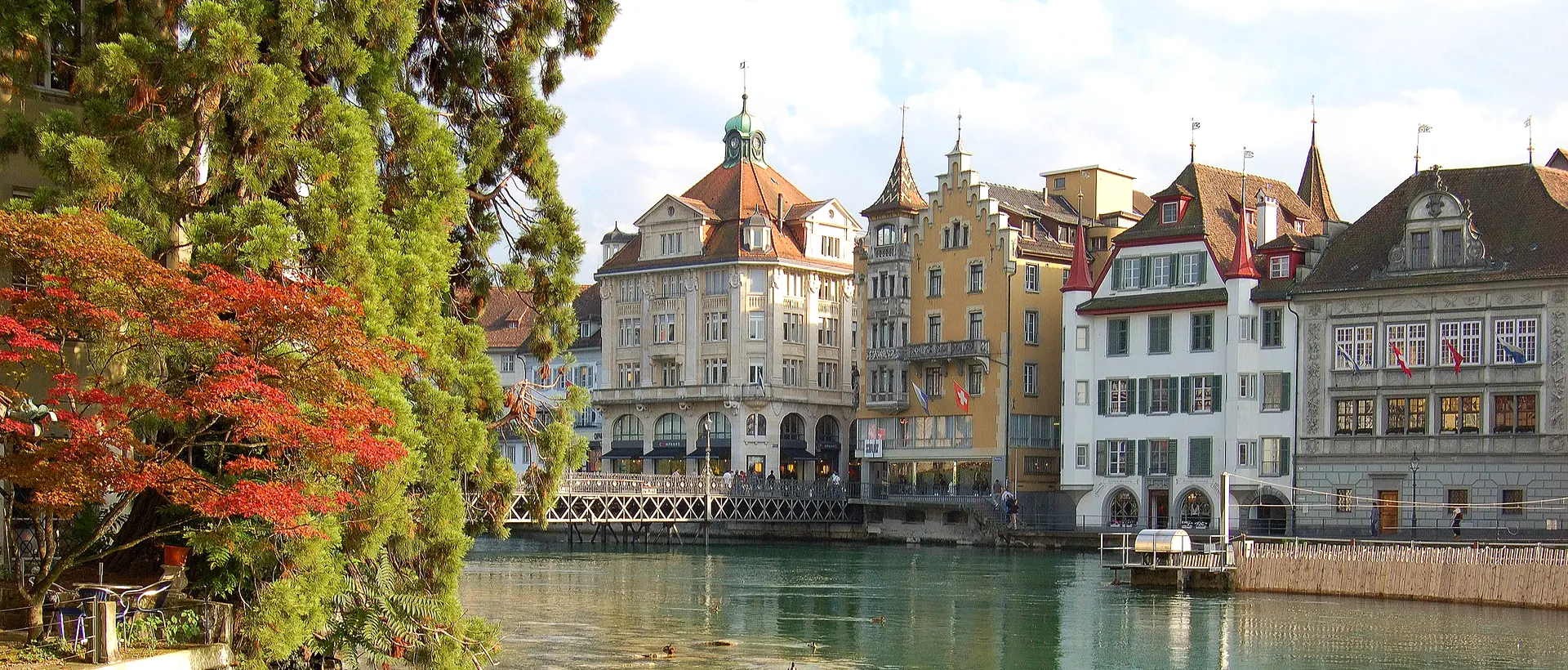
If you are searching for information on living in Lucerne, you are probably picturing a lake, a wooden bridge and a mountain at the end of the street. All of that is real. This page adds the everyday side: who lives here, what the language and rhythm are like, how renting works, and what to do before and after you arrive.
A small city with an international mix
Lucerne (Luzern in German) sits on a lake in central Switzerland, in the canton of Lucerne (LU). It is a compact city. The Federal Statistical Office (FSO) counted 86,699 permanent residents in 2025, and 24,439 of them, or 28.2%, were foreign nationals (FSO, 2025).
In practice, that means you will not be the only newcomer on your street. Neighbors, school classmates and colleagues often come from somewhere else. You can still expect a slower, calmer pace than in the biggest Swiss cities. If you want to see how it differs from a larger business hub, read Arriving in Zurich.
Language and daily life
Expect German in daily life, and in speech you will hear Swiss German, which differs from the German taught in classes. Many people in shops, offices and workplaces also speak English, but official letters, school notices and rental contracts usually come in German. Starting a few lessons before you leave is one of the kindest things you can do for your first months.
A typical week looks like this:
- Short trips on foot, by bike or on public transport, since the center is small.
- Lake walks, swimming in summer and hill views on weekends.
- Shops that close earlier than you may be used to, and quiet Sundays.
An example: a couple moving from Edinburgh might find the size familiar, with the lake replacing the sea and the old town replacing the Royal Mile. A family arriving from Singapore may notice the quiet most of all.
What renting looks like
Housing is usually the first big question. Rents in the city of Lucerne depend strongly on the number of rooms. For the years 2022 to 2024 combined, the FSO gives an average net rent (without utilities) of CHF 1,492 per month across all sizes (FSO, structural survey 2022-2024). The chart below shows the average by size.
These are averages for existing rentals. A new listing today can cost more or less, and the FSO notes that figures for very large homes are less precise, so treat everything here as an order of magnitude. For the wider canton of Lucerne, the FSO reports an average net rent of CHF 1,500 per month in 2024 (FSO, T 09.03.03.01).
How tight is the market?
Availability matters as much as price. On June 1, 2026, the FSO recorded 0.7% of dwellings vacant in the canton of Lucerne (FSO, vacant dwellings 2026). That is a canton-wide figure, not a number for the city itself, but it tells you that you should start early and prepare a clean file.
Preparing a rental file from abroad
Landlords and property managers (régies, or Verwaltungen) in Switzerland usually ask for a complete file before they choose a tenant. Typical items are:
- A copy of your passport and, when you have it, your residence permit.
- Proof of income, such as an employment contract.
- A debt-collection register extract (Betreibungsauskunft), which is a Swiss document and may need to be requested once you are in the country.
- A short cover letter about who will live in the home.
You can test how ready you are with the rental file check. Many landlords also ask for a rent deposit, so ask what is required before you sign.
Schools and children
Public school in Switzerland is organized by the canton and the commune, and the school your child attends usually depends on where you live. That is another reason to choose your home with care. Teaching is in German, so children arriving from English-speaking systems often get language support at first; the commune or school tells you what exists locally.
Families that want teaching in English sometimes look at private or international options. We do not list schools here. Ask the canton what applies to your situation. To think through the school type that fits your child, use the school choice tool.
Getting around and arriving
Lucerne has a railway station in the center and a network of buses and trains linking it to other Swiss cities. Details such as routes, travel times and season passes change often, so check them with the Swiss federal railways (SBB) and the local transport operator when you plan your move.
A good plan is to look at the map first: where you will work or study, where the station is and how far the home is from daily errands. Compare Swiss cities side by side if you are still deciding between Lucerne and a larger city such as Lausanne.
Your first steps, in order
Moving from abroad feels easier when you do it in sequence.
- At home, before you leave: confirm which permit route applies to you with the permit finder, and gather civil documents such as birth and marriage certificates.
- Housing: build your rental file and begin searching. Look at a few neighborhoods and nearby communes, since prices can differ.
- On arrival: report to your commune (the Gemeinde). In many places this has to happen within 14 days. Bring your passport or ID, your permit or work contract and proof of health insurance. Your commune confirms the exact rule and deadline (ch.ch).
- First weeks: set up basic health insurance, a bank account and, for children, school enrollment.
- Permit questions: the cantonal migration office (Dienststelle Migration of the canton of Lucerne) handles residence matters. Its information is at the link in the sources below.
If you want someone to look at your own situation, the request at the bottom of the page lets a specialist review your case. There is also relocation help in Lucerne with more on what that support covers.
Costs compared with home
Switzerland has a reputation for being expensive, and that is fair for rent and health insurance. Budgeting before you leave removes most surprises. For a broader view, see the cost of living in Switzerland, and for readers leaving North America or Britain, Switzerland or the US and Switzerland or the UK.
Frequently asked questions
Is Lucerne a good place for newcomers from abroad?
For many people, yes. It is small, safe-feeling and well connected, and 28.2% of residents are foreign nationals (FSO, 2025), so newcomers are common. The trade-off is that German matters more here than in some larger cities.
What language do people speak in Lucerne?
Expect German, usually Swiss German in speech. Many people also speak English, especially at work, but official papers are normally in German.
How much is rent in Lucerne?
The FSO average net rent in the city is CHF 1,492 per month across all sizes for 2022-2024 (FSO). A one-room home averages CHF 886 and a three-room home CHF 1,458 (FSO). Current listings may differ.
Is it hard to find an apartment?
Vacancy is low across the canton: 0.7% of dwellings on June 1, 2026 (FSO). Start early, and keep a complete file ready to send quickly.
Can I look for an apartment before I move?
Yes, you can search and send applications from abroad. Many landlords like to meet applicants or ask for a Swiss address, so allow time and be ready for a short trip.
Do I need a permit to live in Lucerne?
Most newcomers do. The type depends on your nationality and your reason for coming, such as work or family. The authorities decide, not us. Start with the permit finder for a general idea.
When do I register after I arrive?
You report to your commune. A period of 14 days is commonly cited, but it can vary by commune, so ask yours (ch.ch). You will need ID, your permit or work contract and proof of health insurance.
Which office handles residence permits in Lucerne?
The Dienststelle Migration of the canton of Lucerne handles migration matters (SEM list of cantonal authorities). Its website is linked in the sources below.
What schools can my children attend?
Public schools teach in German and are assigned by where you live. Private and international options exist in Switzerland, but check current details with the canton or the school directly.
Do I need a car in Lucerne?
Many residents manage with public transport and a bike, especially in the center. Your needs depend on where you live and work, so check the connections before choosing a home.
Is Lucerne more affordable than Zurich?
Costs depend on the type of home and the area. Compare current listings and the FSO figures for both cities, and read Arriving in Zurich for the other side.
Sources
- Federal Statistical Office (FSO), resident population (STATPOP)
- Federal Statistical Office (FSO), average net rents in the largest cities
- Federal Statistical Office (FSO), average net rents by canton
- Federal Statistical Office (FSO), vacant dwellings by canton
- State Secretariat for Migration (SEM), cantonal migration authorities
- Canton of Lucerne, Migration Office (Dienststelle Migration)
- ch.ch, the Swiss authorities' guide for residents