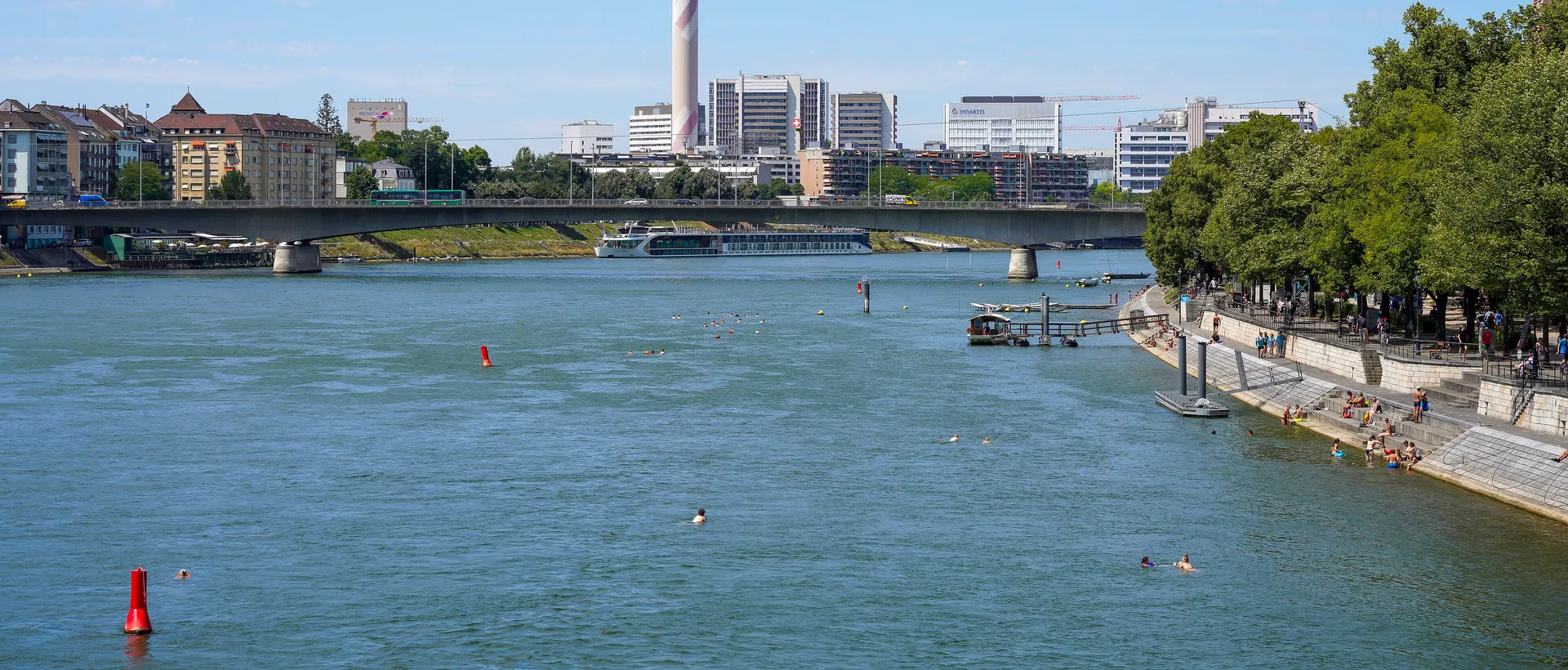
Basel sits where Switzerland meets Germany and France, on a bend of the Rhine. For a family planning the move from London, Chicago, Mumbai or Singapore, it can feel like a small city with a big-city outlook. This page explains what living in Basel looks like before you have ever set foot here, so that each step feels familiar when it arrives.
A city on the Rhine
Basel (the canton is called Basel-Stadt, "Basel city") is in the German-speaking part of Switzerland. Daily life mostly runs in German, in a local dialect on the street and in standard German on paper. English is common in international workplaces, but forms, school letters and neighbors' notes usually arrive in German.
According to the Federal Statistical Office (FSO), Basel had 180,097 permanent residents in 2025. Of these, 72,884 were foreign nationals, which is 40.5% of the population. In plain terms: you will not be the only newcomer on your street, and many people around you have gone through the same steps.
The river is the heart of the city. In summer, people float down the Rhine with a waterproof bag and climb out near the bridges. In winter, the old town around the cathedral is quiet and cozy. Museums, a compact center and cycling lanes make a car optional for many households.
Three countries, one city
Basel is built right on the border. Germany and France are a short ride away, and the airport itself sits on French soil. For newcomers this means weekend trips, markets and hiking are easy to add to ordinary life. Bear in mind that this page is about settling in Switzerland: your home, your registration and your health insurance are Swiss matters, handled with Swiss authorities.
Neighborhoods and nearby communes
Without going into detail that changes from year to year, it helps to think in three layers:
- The old town and the districts around it are lively, with older buildings, cafés and short walks to work.
- Residential districts on the edges of the city are calmer and often preferred by families with young children.
- Nearby communes in the surrounding canton and beyond offer more space. Each commune has its own local office, so the rules for registering can differ a little.
Browsing a few districts on a map, then comparing cities in the city comparator, is a gentle first step from home.
Housing in Basel
Renting is the norm. The FSO reports an average net rent in Basel of CHF 1,395 per month for all dwelling sizes (FSO, cumulated 2022-2024). The figures below show the FSO averages by size of home; larger homes are less precise statistically.
For the canton of Basel-Stadt as a whole, the FSO gives an average net rent of CHF 1,451 in 2024 (FSO). Rents depend heavily on the building, the district and the year it was last renovated, so treat these as orders of magnitude rather than a budget.
The market is tight. The FSO counted 0.78% of dwellings vacant in the canton on 1 June 2026 (FSO). Such a low share means landlords receive many applications for each flat. That is why a complete file matters: identity documents, proof of income, a debt-collection extract and a short cover letter. The rental file check shows what is usually asked for.
Many newcomers begin with a furnished or short-term home to land softly, then look for a lasting lease once they know the neighborhoods. A relocation specialist can explain the options for your situation through the request at the bottom of the page.
Schools and children
Public schools teach in German, and children who arrive without German are usually supported with language classes. Some families prefer an international or bilingual school. Which options exist, what they cost and whether places are open depends on the school and the canton, so it is best to ask the canton directly rather than rely on a list. The school choice tool helps you think through the main types before you write to anyone.
Example: a couple arriving from Toronto with a six-year-old and a toddler might look for a home near a public primary school, then plan childcare separately, since places and costs vary.
Getting there and getting around
The main airport is EuroAirport Basel-Mulhouse-Freiburg. Train connections, journey times and local transport passes change over time, so confirm them with the Swiss railways and the local transport operator when you plan your arrival. Public transport in the city is dense, and many errands are possible on foot or by bicycle.
Registration and the migration office
After arrival, you register with the commune. The usual rule is to register within 14 days, bringing an identity document, your residence or work permit and proof of health insurance (ch.ch). The exact timing can vary by commune and canton, so check with the local office.
For permits, the cantonal authority in Basel-Stadt is the Bevölkerungsdienste und Migration (BdM), listed on the official page of the canton. It handles residence matters, and the State Secretariat for Migration (SEM) lists all cantonal authorities. Whether a permit is granted is decided by the authorities, never by the website or a relocation provider. To see which route could apply, try the permit finder.
Your first days in Basel
A calm order of events looks like this:
Basic health insurance is compulsory for residents, and the rules on timing depend on the authority. A bank account usually follows; see opening a Swiss bank account. To build a personal timeline, use the relocation calendar, and for living costs compare cost of living with where you live today, for example the US or the UK.
If you are also weighing other cities, Zurich and Bern are good places to compare.
Frequently asked questions
Is Basel a good place for newcomers?
Many newcomers find it easy to settle. It is compact, international and well connected, and a large share of residents are foreign nationals (40.5% in 2025, FSO).
What language is spoken in Basel?
German is the everyday language, with a local dialect. English helps in many workplaces, but official letters and school information are normally in German.
How many people live in Basel?
The FSO counted 180,097 permanent residents in 2025.
How much does it cost to rent in Basel?
The FSO average net rent is CHF 1,395 per month across all sizes (FSO, 2022-2024). It rises with the number of rooms, as the chart above shows.
Is it hard to find a flat?
It can be competitive. The vacancy rate for the canton was 0.78% on 1 June 2026 (FSO), so a complete application file is valuable.
Do I need to speak German before arriving?
It is not required to move, but even basic German makes shopping, schools and neighbors easier. Many newcomers start lessons soon after arriving.
Which airport serves Basel?
EuroAirport Basel-Mulhouse-Freiburg. Check current connections with the operator and the railways.
Where do I register after arriving?
With the local commune, normally within 14 days according to ch.ch, though timing varies. Residence permits are handled by the cantonal migration office, the BdM.
What documents are needed to register?
Typically an identity document, a residence or work permit and proof of health insurance (ch.ch). The commune confirms the exact list.
Are there international schools?
Possibly, but this page does not list any because options and places change. The canton can say what is available, and the school choice tool helps you compare school types.
Can I get a permit just by finding a home?
No. A home alone does not decide a permit. The authorities decide, based on your situation and the rules that apply to your nationality and purpose of stay.
Can a specialist help with my move?
Yes. Through the request at the bottom of the page, a relocation company that fits your needs can be matched with you. For wider background, see relocation services.
Sources
- Federal Statistical Office (FSO), permanent resident population
- Federal Statistical Office (FSO), average net rents in the largest cities
- Federal Statistical Office (FSO), average net rents by canton
- Federal Statistical Office (FSO), vacant dwellings by canton
- EuroAirport Basel-Mulhouse-Freiburg
- State Secretariat for Migration (SEM), cantonal migration authorities
- ch.ch, the Swiss authorities' portal