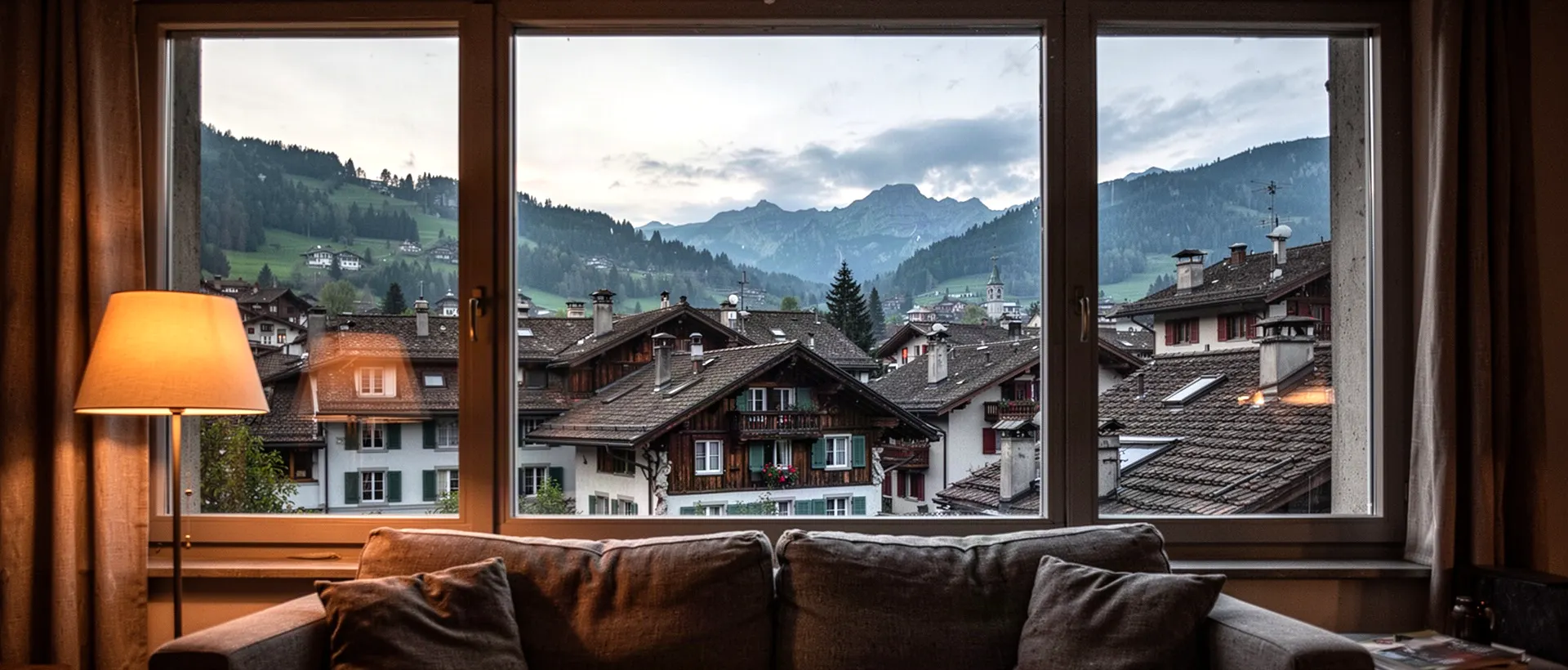
If you are asking how to open a bank account in Switzerland from abroad, the honest answer is: partly from home, partly after you arrive. Some banks let you start the paperwork before you move. Almost all of them finish the job once you have an address and a residence document in Switzerland. The good news is that the order is predictable, and most of the preparation can be done from your sofa.
This page walks you through that order. It is general information, not advice on your personal situation. A specialist can look at your details through the request at the bottom of the page.
Why a Swiss account comes so early
A Swiss account is not a luxury. Landlords often ask for a Swiss payment method, employers pay salaries into a local account, and many bills in Switzerland are paid by a payment slip or direct debit that is tied to a local account number (an IBAN starting with CH). Life without one is possible for a few weeks, but it gets awkward fast.
Think of a family of four arriving from Singapore. The parents want the salary paid on time, the children's school fees to be settled, and the rent to leave the account automatically. All of that is easier with an account that is ready on day one.
The big picture: what happens in what order
Banks mostly follow the same logic. They need to know who you are, where you live, and where your money comes from. Since you may not have a Swiss address yet, the sequence below helps you see which step unlocks the next.
Step 1: prepare your papers at home
Banks are cautious about identity and the origin of funds. Gathering documents before you leave saves weeks later. A typical file includes:
- a valid passport (and a second ID if you have one);
- your employment contract or an offer letter, or proof of income if you are self-employed or retired;
- a recent proof of address in your current country, such as a utility bill or a bank letter;
- documents for family members who will hold an account, including marriage and birth certificates when relevant;
- a tax identification number from the country where you are tax resident.
Many banks accept documents in English, German, French or Italian. Anything else may need a certified translation. Ask the bank which language versions it accepts before paying for translations.
Step 2: understand what you are actually opening
Most newcomers want three things: a current account for daily life, a debit card, and online banking. A savings account is optional. Some people also ask about a second account in a foreign currency, which is a separate discussion.
A few terms you will meet:
- Current account (Privatkonto, compte privé): the everyday account where salary arrives and bills leave.
- Debit card: the most common Swiss card. Credit cards usually come as a separate product.
- Payment slip (QR-bill): the standard Swiss invoice format. Online banking can scan it with a phone.
- TWINT: a popular Swiss payment app that links to a Swiss account.
Step 3: check what the bank can do from abroad
This is where practices differ most. Broadly, banks fall into three groups:
- Branch-only banks. They want you in person with your residence document. You cannot finish from home, but you may be able to book an appointment before you land.
- Banks with remote onboarding. They allow a video call or an online identification, sometimes before you hold a Swiss address. Rules on who qualifies vary.
- Digital-first providers. They are quick to set up, but the product range and the conditions for non-residents differ.
None of this is a given. Each bank sets its own conditions, and a request made from abroad can be declined. That is why it helps to apply to more than one place at the start. For a deeper look at this stage, see opening an account before you arrive.
Step 4: register where you live
After you move, the municipality is the next official stop. Registering your arrival with the commune (Gemeinde in German-speaking areas) is generally due within 14 days, although the exact rule can vary by municipality or canton. You normally bring your ID, your residence or work permit, and proof of health insurance.
Banks often ask for the municipality's confirmation or your residence card. So the quicker you register, the sooner the bank can complete your file. If you are still working out which permit applies to you, the permit finder gives a general orientation.
Step 5: sort out health insurance in the same period
This is not a banking step, but it overlaps with your first weeks, and your bank account is the usual route for paying it. Basic health insurance is compulsory for people who live in Switzerland, and it has to be taken out no later than three months after you take up residence. If the deadline is met, cover starts back on the date you settled. Missing it can bring a late surcharge, and the canton can assign an insurer. Most people therefore set up a direct debit or a standing order from the new account.
Step 6: finish identification and activate the account
Once you have the address and permit, the bank completes its checks. Expect to sign account-opening forms, a tax-status declaration, and sometimes a form about who benefits from the account. You then receive a card and login details by post, often in separate envelopes. Posted items can take a little time, so a temporary address, such as temporary housing, still needs a reliable mailbox.
Differences by nationality and country of departure
Your passport and your tax status shape what a bank asks.
- UK. Documents usually travel well. Proof of address is a common request, and a bank statement from a UK bank is often accepted as support.
- US. Some banks have extra procedures for people who are US tax residents. Read the dedicated page on banking in Switzerland as a US citizen.
- India, Gulf states, Asia. Banks may ask for more detail on the source of funds, and translations of certificates sometimes matter.
- Canada and Australia. The process is close to the UK pattern, with a tax identification number and a proof of address.
Whether you come from the EU/EFTA or from a third country affects your permit route, and your permit in turn affects banking. The two regimes are described by the State Secretariat for Migration; the permit finder is a gentle starting point.
Common pitfalls
- Waiting until you land to start. The identification and mail steps take time, so a late start can leave you without a card in your first weeks.
- Mixing up addresses. Use one consistent address across the contract, permit and bank forms.
- Forgetting the tax forms. Missing tax identification details are a common reason files stall.
- Assuming one bank fits everyone. Conditions for newcomers change, so ask directly.
- Ignoring cash needs. Keep a small amount in local currency or a travel card for the first days.
A short checklist before you fly
- Passport valid for the whole planned stay
- Employment contract or proof of income, in a language the bank accepts
- Proof of address from your current country
- Tax identification number from your current country
- Marriage and birth certificates for family accounts
- A short list of banks to contact, with their requirements noted
- A Swiss mailing address for cards and letters
You can also build your own list with the personal checklist tool and place each step on a timeline with the relocation calendar. For the full everyday picture, opening a Swiss bank account as a newcomer goes deeper once you are in the country.
Where the cost of living meets your account
Opening an account is only the start. Rent, insurance and daily spending flow through it, so it is worth reading the cost of living in Switzerland before you pick a package. If your move is for work, tax at source explains why your payslip may look different from the one you know.
Frequently asked questions
Can I really open a Swiss bank account before I move?
Sometimes. A few banks start the process from abroad, but most finish it only when you show a Swiss address and a residence document. Rules differ by bank.
Do I need a Swiss address to apply?
Many banks ask for one at the final step. Some accept a first request without it, then complete identification after you arrive.
Which documents do banks usually ask for?
A passport, proof of address, proof of income or employment, and a tax identification number. Family members add certificates.
Can I use documents in English?
Often yes, especially for English, German, French or Italian. Other languages may need a certified translation.
Is a video call enough to open an account?
At some banks, yes, as part of remote onboarding. Others insist on an in-person visit.
How long does it take?
It depends on the bank, your nationality and how complete your file is. Posted cards and letters add time.
Can a bank refuse me?
Yes. Banks decide on their own conditions, and a refusal is possible. Applying to more than one institution is common.
Do I need a job before opening an account?
Not always, but proof of income helps. Employed, self-employed, retired and student profiles are treated differently.
Can my spouse and children have accounts?
Usually yes. Spouses commonly hold their own or a joint account, and children's accounts are offered by many banks with a parent's signature.
What happens if I arrive without an account?
You can manage for a short while with a foreign card and cash. Salary and rent are easier with a local account.
When do I have to register with the municipality?
The usual rule is to announce your arrival within 14 days, though it can vary by municipality or canton. Your commune will confirm the details.
Does health insurance affect my banking?
Indirectly. Basic health insurance is compulsory within three months of taking up residence, and premiums are commonly paid from a Swiss account.
What if I miss the health insurance deadline?
If the deadline is respected, cover is retroactive to your arrival date. If it is exceeded, cover starts at affiliation, a surcharge can apply, and the canton may assign an insurer.
Is a US citizen treated differently?
Some banks apply extra procedures to US tax residents. The page on banking as a US citizen explains the general picture.
Can I keep my home-country account?
Generally yes. Many newcomers keep it for a while and move money gradually.
What is an IBAN and why does it start with CH?
An IBAN is the international format for an account number. Swiss ones begin with CH, and employers and landlords use it.
Which card will I get?
Usually a debit card. Credit cards are separate products with their own conditions.
Can I pay rent from a foreign account?
Possible in some cases, but a Swiss account is smoother. Landlords and agencies often prefer it, as described in renting your first home.
Does my permit type change anything?
It can. Banks look at your residence status, and the rules differ between EU/EFTA nationals and third-country nationals.
What should I do first if I feel lost?
Start with the documents list above, then ask a specialist to look at your details through the request at the bottom of the page.
Is the account useful for taxes?
It helps keep a clean record of income and payments, which is handy for your first Swiss tax return. The authorities and a qualified adviser decide what applies to you.